Global Space Exploration Conference

L'Enfant Plaza Hotel, Washington, DC, USA

Index.php

25 May 2012

Plenary 5: Building the Political Consensus
Comments Off

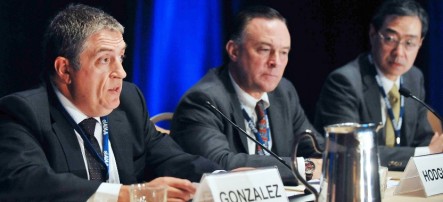
Mr Gonzalez, Mr Hodgkins and Mr Katase during GLEX 5th plenary event

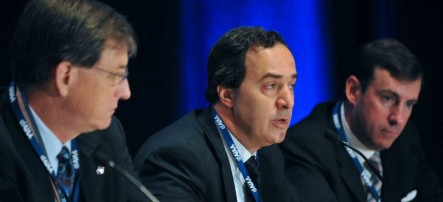
This panel, featuring: Augusto Gonzalez, head of the European Communiy Directorate-General Enterprise and Industry’s Space Policy Unit; Hirofumi Katase, deputy secretary-general for the Cabinet Secretariat, Secretariat Headquarters for Space Policy, Government of Japan; and Kenneth Hodgkins, Director, Office of Space and Advanced Technology, U.S. Department of State, explored the political barriers which hamper space exploration, and offered thoughts on how to surmount those barriers to ensure a sustainable future for exploration.

⚡ [Flash Content Retired]

The sessions’ moderator Jeffrey Hoffman, professor of the practice, Department of Aeronautics and Astronautics, Massachusetts Institute of Technology (MIT), summed up space exploration as: “Taking money, the public’s money, and using it to do things which the public really doesn’t understand for the betterment of the public.” He went on to point out that this lack of understanding can cause political tensions which result in programs not receiving proper funding, and which block international partnerships for further exploration efforts.

Each of the panelists then reviewed the ongoing political efforts in their nations to further exploration efforts. Katase talked about the Japanese experience, where space policy is a major part of national policy and enjoys substantial government and public support, especially after Japan’s successful Hyabusa mission.  Gonzalez talked about the value of space to the European Community, and how an integral part of the EU Charter discusses the exploration of space for the benefit of humanity. Hodgkins talked about the need for more international partnerships, and pointed toward the International Experimental Thermonuclear Reactor as a model for future exploration partnerships. He also lamented the International Traffic in Arms Regulations that often hamper U.S. cooperative efforts, especially with the Chinese. One thing that all speakers agreed on was the need for international partnerships to further the exploration enterprise – pointing out that exploration costs now exceed the ability of most nations to pay for them on their own.

All speakers pointed to the International Space Station as the model example of how international partnerships can succeed. All also pointed out that further exploration will be justified by the value of its discoveries, and the benefits those discoveries will bring to humankind. They urged that the international community continue forums like GLEX, to continue talking about exploration and to continue to erode the barriers which prevent true international cooperation.

25 May 2012

Keynote 2: Exploring the Moon and Asteroids: A Synergistic Approach
Comments Off

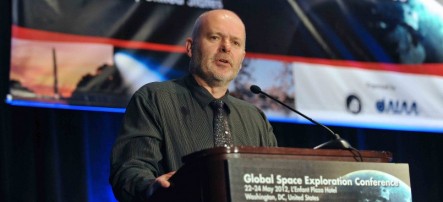
Clive Neal

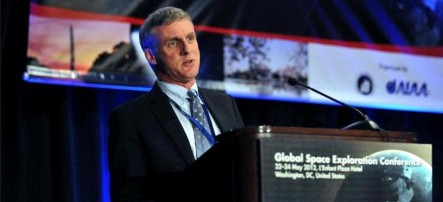
Dr. Clive R. Neal of the University of Notre Dame delivered the second keynote address of the GLEX conference.

⚡ [Flash Content Retired]

Neal’s talk explored the synergies between lunar research and asteroid exploration.  Neal began by reminding the audience that it will be synergies between industry, government, and academics what will drive the next round of space exploration, and that these partnerships and joint projects will usher in a new era of exploration.

Neal reviewed the history of lunar exploration, and then went on to lay out a case for why lunar exploration is the natural stepping-stone to exploration in the rest of the universe.  According to Neal, factors supporting the use of lunar exploration as a stepping-stone for exploration efforts on asteroids and other near earth objects include: That it is an airless bodies which features a harsh dusty environment, the surface contains rocks and other structures as would be found on asteroids, there are large temperature swings between night and day, and the soil and its substructure contain volatiles and metals, which could be mined. The only downside to using the Moon that Dr. Neal foresaw was that the gravitational field is slightly different from that which would be found on an asteroid, and that would make a difference in some of the training.

In the end, Neal summed up his reasons for using the Moon to prepare for future missions along three axes of argument: Science – pursue science to address fundamental questions about the Solar System, and the universe 2) Feed Forward – use moon to prepare for Mars and NEO exploration, and 3) Sustainability, keep extending our presence on the Lunar surface, using the materials found there to help us achieve that goal.

24 May 2012

Plenary 4: Human and Robotic Exploration: A Scientific Perspective
Comments Off

Chris McKay during the COSPAR Panel

The 4th Plenary Session of the Global Space Exploration Conference addressed the importance of continued exploration of the Moon, Mars, and space, how these exploration missions will answer important questions about human existence, how our solar system was formed, and what our future exploration prospects may be. All of the panelists expressed the belief that international cooperation through robust national, private, and entrepreneurial space programs will be essential to these efforts. They were also in agreement that the international scientific community can provide a clear and credible vision for a global planetary exploration science roadmap, and that many groups have already invested significant time and resources to this very task.

⚡ [Flash Content Retired]


• Julie Robinson, ISS Program Scientist, NASA, spoke about discoveries that exploration can bring us, breaking them down into three categories: Pure discoveries, discoveries that can only be made in space; discoveries made solely for Earth’s benefit; and discoveries made through space exploration.

• Stephen Mackwell, Director, Lunar and Planetary Institute, discussed the continuing importance of the Moon to space exploration initiatives and research, and how international interest in exploration of the Moon has blossomed in recent years, spurring seven separate robotic exploration missions to the Lunar surface. According to Mackwell, the important uses for the Moon are the ability to conduct pure radio-telescopic explorations of the solar system, free of the radio interference on Earth, and using the moon as the ultimate test-bed for robotic equipment, before it is sent deeper into the solar system. Mackwell stated that current robotic exploration of the Moon will give way to continued human exploration, and perhaps settlement, of the Lunar surface.

• Junichiro Kawaguchi, Senior Fellow, JAXA, stressed the importance of exploring near earth objects before the Moon, stating the Moon is old and we have been there, we should press on and make new discoveries. He provided a comprehensive review of past and present efforts to visit comet, asteroids and other small, near earth objects. Kawaguchi also advocated for the establishment of deep-space ports and way stations, which would serve crews traveling out to further exploration destinations in the universe, by storing food, supplies, and fuel for them to utilize along their journeys.

• Chris McKay, Senior Space Scientist, NASA, discussed the ongoing search for life in the Universe, but was swift to point that the life we are looking for is not the life we are familiar with, but rather is some form of other biological life quite different than ours. He discussed the importance of focusing this search on Mars, Europa, Enceladus and Titan, as all of those bodies show signs of the chemical composition, water and climate necessary for life.

The plenary was moderated by Pascale Ehrenfreud, Space Policy Institute, George Washington University, United States.

24 May 2012

Plenary Panel 3: Capabilities for Human Exploration
Comments Off

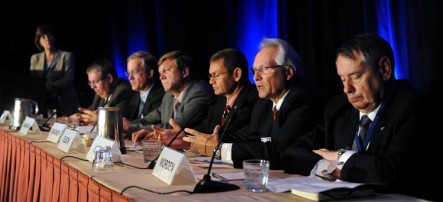
Participants of Plenary Panel 3: Capabilities for Human Exploration

The third plenary session brought together several distinguished experts in the field of space exploration, to participate on a panel discussion which grappled with the capabilities for human exploration. Moderated by Space News’ Brian Berger, the panel debated several topics relative to the ability of humans to explore the cosmos.

Participants were:
• Joy Bryant, Vice President and Program Manager, ISS, The Boeing Company, United States
• Alexander Derechin, Deputy General Designer (Strategy, Business Development, International Cooperation), S.P. Korolev Rocket and Space Corporation “Energia”, Russia
• Clayton Mowry, President, Arianspace Inc., United States
• Dan Dumbacher, Deputy Associate Administrator for Exploration Systems Development, NASA, United States
• Mark Sirangelo, Executive Vice President and Chairman, Sierra Nevada Corporation, United States

Topics of discussion during the sessions ranged from debating if Mars or a Near Earth Object (NEO) should be the immediate focus of exploration efforts; the types of rockets necessary to propel explorers to Mars and beyond; the importance of the ISS to future exploration efforts – both as a test-bed for better understanding the effects of the space environment on the human body, and a staging area for future exploratory expeditions; and the need for international coordination in all phases of the exploration enterprise.

The panel was in total agreement on several discussion points: That Mars should be the focus of international exploration efforts for the present, and then the international community can take those lessons learned from mars and apply them to exploring asteroids and other NEOs. That a rocket of over 100 metric tons will be needed to get to Mars, or any other spot beyond the moon, thus nations need to continue to work to develop their heavy lift capabilities; and that all exploration missions must be international in scope due to extensive program costs. Interesting side-points of discussion included Mark Sirangelo’s discussion of Sierra Nevada’s “Blue Horizon” and what it will offer in terms of capabilities and its ability to be used for more than one mission, and Derechin’s call for more standardized equipment across the exploration system as a means of reducing program expense.

The last point of agreement between the panelists was that the ISS has played, and will continue to play, a key role in advancing the future of exploration. Each panelist took time to discuss the key contributions that ISS has made to understanding the physiological and psychological demands that space habitation and operations put on the human body and mind, and each panelist was adamant that we must use those lessons to continue to evolve safer, more reliant, and more responsive technology to keep human life in space safe.

24 May 2012

Keynote on Mars Exploration
Comments Off

Steve Squyres

Introduction and Welcome: Waleed Abdalati, Chief Scientist, National Aeronautics and Space Administration (NASA), United States

Speaker: Steve Squyres, Goldwin Smith Professor of Astronomy, Cornell University, United States


The first keynote address of the Global Space Exploration Conference featured Dr. Steven Squyres speaking about exploration efforts on Mars. His address summarize where the international space community stands on Mars exploration, what he feels will come next in exploration, and what must be done to achieve those next steps.

He provided a thorough review of all previous Mars exploration missions, discussing each of the specific finds that the explorations made – like ice on the planet, evidence of past abundant water, and evidence of an ancient magnetic field which gave Mars an atmosphere that was probably warm and water filled at one point. As far as next steps, Squyers discussed upcoming missions to study trace-gas elements in Mars’ upper atmosphere, missions which will study the interior of the planet – with a particular emphasis on the geologic history of Mars; and efforts to return more samples of Martian soil to Earth for more intensive study and research.

Squyers included in his presentation with a discussion of the international cooperation that will be necessary to complete these studies. Given the cost, complexity, and challenges involved, Squyers believes that only international cooperation will make current and future Mars exploration efforts successful. He condensed his view into this short summary – “I don’t know the how of how we do this, that’s up to you. But I know what we need: 1) We need big rockets; 2) We need orbiters – most have been American or European, but other nations like China or India are getting involved with their lunar missions; 3) We need to land – even if we do it differently every time; and 4) we need rovers, be they US, Russian, European, or those of another country.”

Squyers finished with this thought on the necessity of continued international partnerships in exploration, explaining: “In a book shelf on my office at home, I have a vial with stuff from mars. But I would like more, especially in my laboratory. There is no way to get what we want without going there and getting it, and it’s too big a job for one agency to do alone.”

23 May 2012

“Perspectives on Exploration” Panel
Comments Off

PE2 Perspectives Panel

GLEX’s second plenary discussion was entitled “Perspectives on Exploration” and brought together: Michael Menking, Senior Vice President, Orbital Systems and Space Exploration EADS Astrium; Alexey Krasnov, Head of Manned Spaceflight Department, Federal Space Agency (Roscosmos); John Elbon, Vice President and General Manager, Space Exploration, The Boeing Company;  John Karas, Vice President and General Manager, Human Space Flight, Lockheed Martin Corporation; Simon “Pete” Worden, Center Director, NASA Ames Research Center. The panel was moderated by Kathy Laurini, Senior Advisor, Exploration and Space Operations, NASA, discussing what exploration is now, and what it might be in the future. Subjects in the panel included: What drives exploration – capability or destination? Can exploration costs be more efficiently controlled through cooperation and streamlining mission protocols? What must be done to convince the public that space exploration missions are worth their costs? How can we effectively convince lawmakers that science matters, to the degree that our exploration budgets are insulated against the tendency to deplete them for other purposes? What role will government play in a space exploration business model that looks to be more privatized going forward? Will private space entities eventually turn to a settlement and colonisation model going forward, and will this open up space settlement and colonisations in ways that were not thought of in previous decades? And lastly, should we be pessimistic or optimistic about the future of exploration, given ongoing questions about financing such missions? (more…)

23 May 2012

Heads of Agency Panel
Comments Off

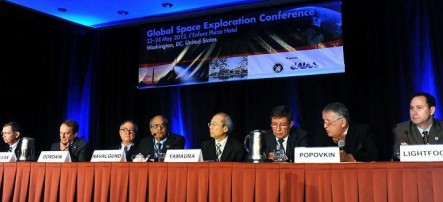
PE1 HoA Panel - Dickman,Maclean, Dordain, Navalgund Yamaura, Popovkin, Lightfoot

The Global Space Exploration Conference (GLEX) got off to a good start on Tuesday morning with the Heads of Agency Plenary Panel. Bringing together: Jean-Jacques Dordain, Director General, European Space Agency; Steve MacLean, President, Canadian Space Agency; Vladimir A. Popovkin, Head of the Russian Federal Space Agency; Yuichi Yamaura, Associate Executive Director, Japan Aerospace Exploration Agency (JAXA); RR Navalagund, Prof. Vikram Sarabhai Distinguished Professor, Indian Space Research Organisation, and Robert Lighftoot, Acting Associate Administrator, NASA. (more…)

21 May 2012

Young Professional Event
Comments Off

YP Keynote Audience

On Monday, 21 May 2012, the dynamic keynote speaker Tim Pickens, Chief Engineer an Commercial Space Advisor at Dynetics as well as the Team  Leader for the Rocket City Space Pioneers Google Lunar X PRIZE Team delivered his unique presentation entitled “From Hobby to the Moon”.

Timothy Pickens

This event was co-sponsored by the Boeing Company and United Launch Alliance.

This keynote lecture was followed by a networking reception where early career space professionals could meet senior agency and industry executives.

Platinum Sponsor:

Lockheed Martin

Gold Sponsor:

Boeing Company

Bronze Sponsors:

United Launch Alliance
Battelle
Pisces - Pacific International Space Center for Exploration Systems

Participation of:

Canadian Space Agency China National Space Administration European Space Agency Indian Space Research Organisation Japan Aerospace Exploration Agency National Aeronautics and Space Administration Russian Federal Space Agency

Partner organisations:

International Academy of Astronautics International Institute of Space Law Comitee on Space Research International Space Exploration Coordination Group International Lunar Exploration Working Group

Conference Supporters:

Canadian Aeronautics and Space Institute